







Organized retail crime, sometimes called organized retail theft, refers to coordinated, repeat, and profit-driven theft carried out by individuals or organized retail groups who target retailers to resell stolen merchandise. Unlike a single shoplifting incident, organized retail crime (ORC) spans multiple stores, multiple incidents, and often multiple jurisdictions, which is why it is so difficult for any one retailer to see on its own.
That said, there is no single, universally accepted definition of organized retail crime across the retail and law enforcement industries, and that gap matters more than it might seem.
What is organized retail crime (ORC)?
The Loss Prevention Research Council (LPRC) surveyed 146 senior loss prevention professionals, representing 60 retailers across grocery, general merchandise, apparel, home improvement, and other sectors, and asked them to define organized retail crime in their own words. The result was 116 different definitions, with no two identical.
That means that when two retailers, or a retailer and a law enforcement agency, talk about organized retail crime, they may not be talking about exactly the same thing. Definitions vary by retailer and by police agency because each organization classifies incidents, sets dollar thresholds, and tracks repeat activity differently.
Based on the common threads across those 116 definitions, LPRC researcher Cory Lowe proposed a working definition: Organized retail crime can be described as predatory crime in which one or more persons of interest knowingly and intentionally coordinate or plan criminal activity to victimize one or more retailers, on one or more occasions, with the intent of financially profiting themselves or a broader criminal enterprise, through the acquisition of cash, financial instruments, or merchandise that can be resold, returned, or exchanged for profit.
Three characteristics show up consistently across definitions and form the closest thing the retail industry has to common ground.
Organized
In LPRC's analysis, 46 of the 116 definitions referenced a "group," and 34 specifically described collaborative coordination among individuals. This does not always mean a hierarchical criminal organization. Coordination can range from loosely connected individuals who repeatedly hit the same targets to highly structured organized retail groups with defined roles. Either way, the presence of planning and coordination, rather than a single person acting on impulse, is what separates organized retail crime from opportunistic theft.
Repeat
Organized retail crime rarely involves a single incident. LPRC's definitions referenced multiple occasions, multiple store locations, or multiple retailers being targeted by the same persons of interest over time. This is also where the pattern becomes hardest to see from inside a single store. A person of interest who hits five different stores once each can look, from any one store's perspective, like five unrelated, low level incidents.
Profit-driven
Twenty six of LPRC's 116 definitions specifically cited personal financial gain as the purpose behind the activity, and ten referenced funding a larger criminal enterprise. The defining feature is that stolen merchandise is not for personal use. It is acquired specifically to resell, return, or exchange for profit, often through fencing operations, online marketplaces, or other resale channels.
.webp)
Organized retail crime vs. organized crime
Organized retail crime is often confused with the broader legal and criminological concept of organized crime, but the two are not the same. Organized crime is a wide category that includes drug trafficking, racketeering, human trafficking, and other criminal enterprises, typically defined and prosecuted under statutes like the federal Racketeer Influenced and Corrupt Organization (RICO) Act.
Organized retail crime is a retail-specific subset of criminal activity focused on the theft and resale of merchandise from retail stores. The FBI and the National Retail Federation both treat organized retail crime as its own category of concern, distinct from general organized crime, though the two can and do intersect. I had the honor of serving as the Deputy Assistant Director of Transnational Organized Crime while working at Homeland Security Investigations (HSI). While working organized retail crime cases, I noticed that the same networks involved in retail theft are sometimes connected to other criminal activity. Operation Boiling Point, HSI's response to groups profiting from retail and cargo theft, found these networks connected to narcotics trafficking, human trafficking, money laundering, and, in some cases, terrorism. Some individuals in organized retail crime groups treat the activity as their job: highly organized, deliberate, and connected to other regions. There’s a journey for organized theft, and the in-store event is often just the beginning.
The Organized Retail Crime Act
Lawmakers have begun recognizing organized retail crime as its own legislative category. The Combating Organized Retail Crime Act passed the US House of Representatives in May 2026 and is now awaiting Senate action. The bill would establish a coordination center within Homeland Security Investigations focused specifically on organized retail and supply chain crime, treating the two as connected problems rather than separate categories, and would allow prosecutors to aggregate stolen merchandise values across a 12-month period rather than prosecuting each theft in isolation.
Types of organized retail crime
Organized retail crime is a collection of related offenses, most commonly involving some combination of theft, fraud, and resale. In practice, the specific methods most often associated with repeat and organized offending include:
- Cart pushouts, where merchandise is removed from a store without payment, often in bulk.
- Concealment, where merchandise is hidden to avoid detection at checkout.
- Self-checkout fraud, including intentional non-scans at self-checkout stations.
- Gift card draining, where gift cards are tampered with in store, then later activated or drained once a customer unknowingly purchases them.
- Return and refund fraud, using stolen merchandise, counterfeit receipts, or manipulated return processes to convert stolen goods into cash or credit.

These methods often overlap within the same network. A group connected through cart pushouts at one set of stores may also be tied to gift card draining or return fraud elsewhere.
Signs you may be dealing with organized retail crime
Rather than asking whether an incident meets a specific threshold, retailers and law enforcement officials can ask a set of questions about the incident itself. These signs help identify an isolated incident from one that may be part of broader organized retail crime.
- Does the incident involve a repeat offender or persons of interest already known to your organization?
- Does it involve more than one person working together?
- Does a single event involve unusually large quantities of product?
- Are the targeted products ones already associated with resale value, such as items frequently flagged in organized retail theft cases?
- Do the tactics involved suggest planning or sophistication, such as tools or techniques designed to defeat store protections?
- Is there any indication the merchandise is being resold, whether through local pawn transactions or online marketplaces?
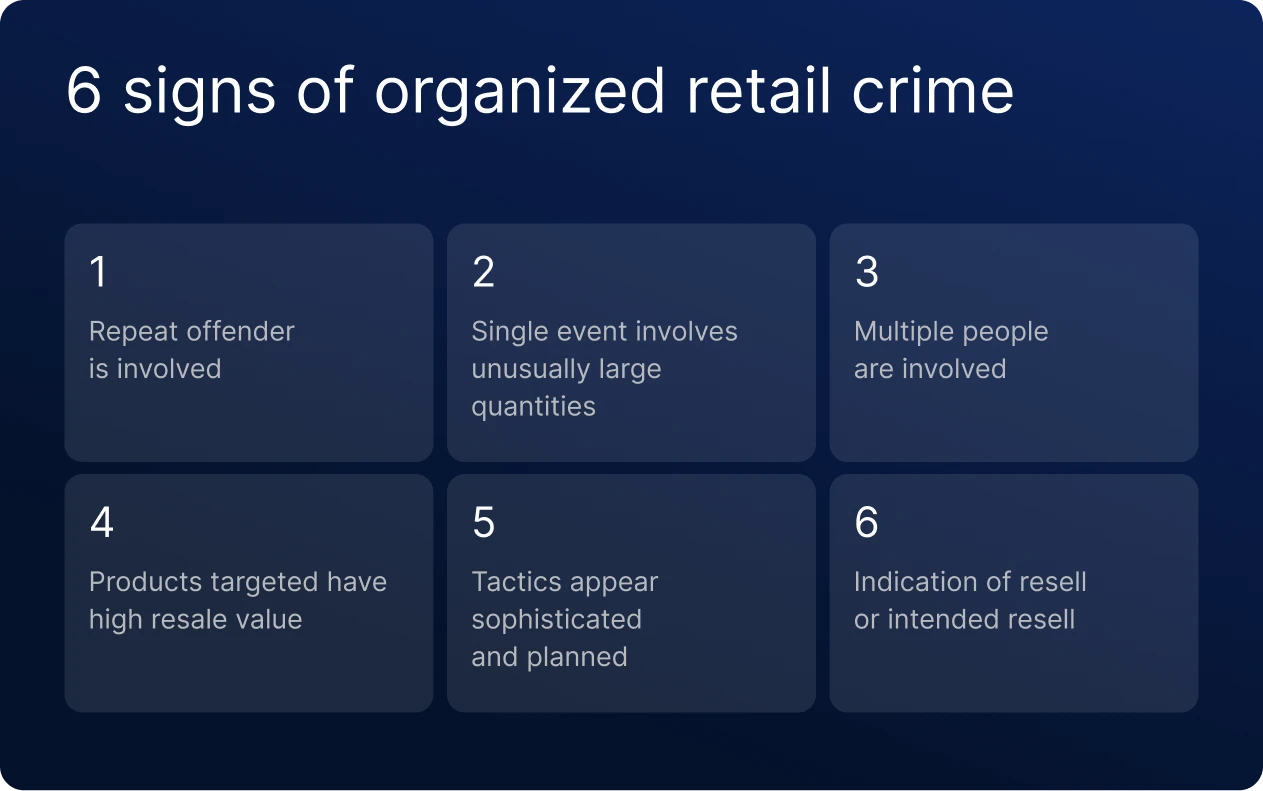
The more of these signs are present, and the more they recur across stores or time, the stronger the case for treating an incident as part of an organized retail crime pattern rather than a one off.
What organized retail crime looks like in practice
What makes organized retail crime difficult to investigate is that the full picture rarely exists inside a single store, or even a single retailer.
One beauty retailer’s organized retail crime team uses a 24/7 intelligence-powered security operations center to monitor activity across the retailer's 1,500-plus stores. In one case, a group of persons of interest hit multiple stores in the Midwest for an estimated $30,000 to $40,000. At first, it looked like a standalone incident, but once it was entered into Auror, it immediately linked to a separate investigation. One of the retailer’s organized retail crime managers had been working that case for eight months in a completely different region. The two investigations with the same persons of interest but in different geographies had been running in parallel without either team knowing about the other.
Once connected, the case became a single, much larger investigation involving more than $200,000 in losses, coordinated surveillance across regions, and involvement from Homeland Security Investigations as the case pointed toward a fencing operation.
That outcome depended entirely on the incident being documented and connected. As Mark Buglione, Senior State Police Investigator with the New York State Police, shared at NRF Protect 2026, a retailer working alone can typically only bring law enforcement a single store case, and single store cases tend to be the lowest priority in an investigator's queue.
“The network view is what is the difference between arresting just boosters or building for us a criminal enterprise case where we're identifying all the boosters, we're identifying the fencing operations, and we're able to tie that in a big conspiracy and knock it out.”
The scale of organized retail theft
Auror's 2025 Retail Crime Insights Report, based on more than two million events, puts real numbers behind these patterns.
- A small share of persons of interest drive most of the loss. In the US, 10% of offenders accounted for 60%+ of total event value, and that’s a consistent theme over the last decade.
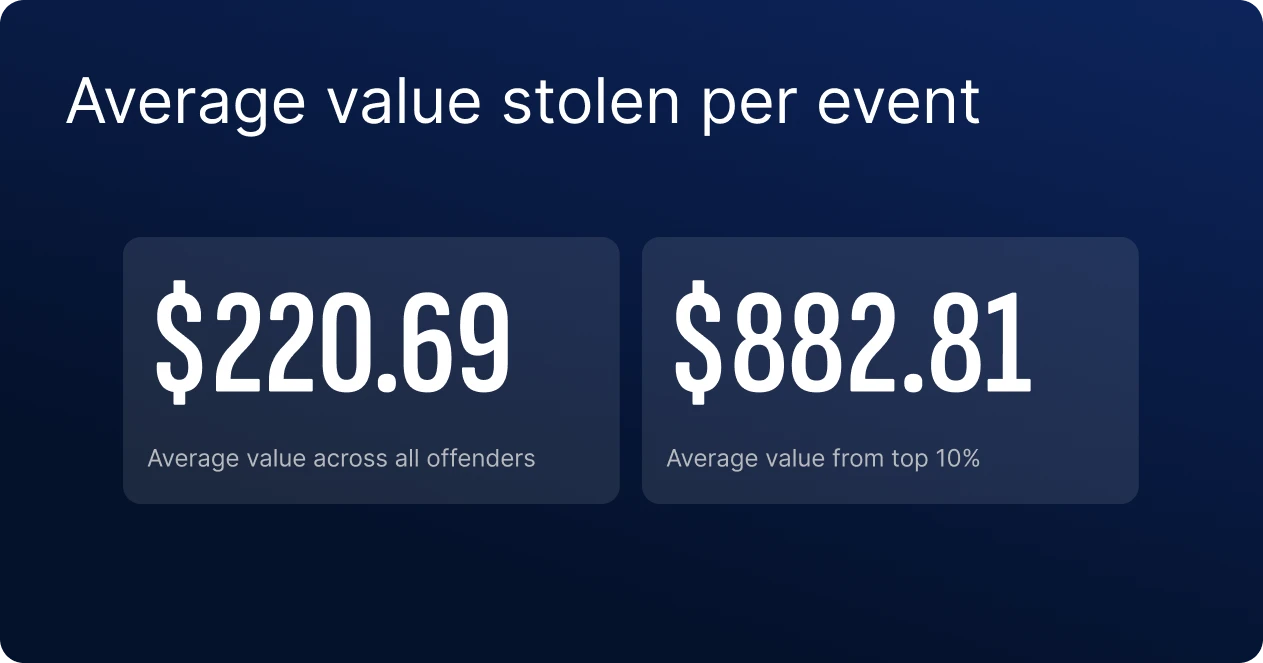
- High value events are concentrated at the top. The average event value in the US was $220.69, but the average event value among the top 10% of offenders was $882.81.
- Repeat offending is a major share of total crime, and it's growing. Repeat offenders accounted for 27% of all retail crime reported worldwide and 29% in North America.
- Repeat offenders move across locations. One in four repeat offenders in North America offended at more than one store location.
- Repeat offending is tied to higher event values. For instance, one popular beauty retailer found that their repeat offenders had 85% higher event values.
How retailers and law enforcement respond to organized retail crime
One common objection to sharing intelligence about organized retail crime is competitive sensitivity. Retailers are sometimes hesitant to share information about persons of interest with other retailers, viewing it as a competitive liability rather than a shared problem.
The reality is that the offenders targeting one retailer are very often targeting every other retailer in the room too. Competitive hesitation between retailers is precisely the gap organized retail crime exploits, since offenders move freely across retailers when retailers do not share what they know.
For retailers building a response, regardless of size, a few practices consistently show up in how effective organized retail crime programs operate:
- Communicate internally and externally. Teams need to understand why the work matters, business leaders need visibility into what the program produces, and law enforcement partners should be recognized when cases are resolved.
- Don't treat policy as fixed. Many restrictions on information sharing were written years ago and have not been revisited since.
- Build the law enforcement relationship before a case requires it. The retailers seeing the strongest outcomes are the ones who invested in structured collaboration in advance, not after an incident escalated.
- Treat every documented incident as potentially connected to something larger. A single event that looks minor in isolation may be the missing piece in a large-scale theft investigation already underway elsewhere.
Combating organized retail crime takes connected intelligence
Organized retail crime is, by definition, a problem that crosses store, retailer, and jurisdictional boundaries. No single store, investigator, or agency can see the full picture alone, which is exactly why the response has to be collective rather than isolated.
The Auror Network connects retailers and law enforcement agencies so that persons of interest, vehicles of interest, and patterns of organized activity become visible across organizational lines rather than remaining siloed in any one store's incident log. When retailers and law enforcement act on the same connected picture, organized retail crime stops being invisible by default.