







Retail crime isn't random. Many incidents that appear isolated are connected to broader, organized crime. It's a vicious cycle, and closing it starts with focusing on known threats.
Auror's data across 85,000+ stores shows that 10% of offenders drive the majority of crime, and repeat offenders are more than twice as likely to be violent in North America. Knowing the outsized impact of prolific offenders has moved the conversation from whether retailers have a repeat offender problem to whether store teams have enough context to respond appropriately. This shift has sparked demand for responsible recognition technology among LP teams.
Loss Prevention Research Council (LPRC) research director Cory Lowe and Auror VP of Sales, North America, Trevor Symons shared how responsible Risk Detection is stopping the cycle in a recent LPRC webinar, summarized below.
Key takeaways
- Offending is a cycle. What you document after one incident shapes the response to the next.
- A detection without context forces a store team to guess, and that is where bias enters.
- Risk Detection works as two complementary layers to detect known threats before an incident occurs
Why proactive versus reactive is the wrong question in loss prevention
In a recent LPRC webinar, Cory Lowe argued that the loss prevention industry's default mental model of theft (one person, one store, one event) is why so many programs are pointed at the wrong problem.
"A lot of people think about offending as a linear event. They think, okay, you have this individual who comes in the store, they steal from you, and then they're gone. [But] it's actually a cycle, and each of these incidents are connected."
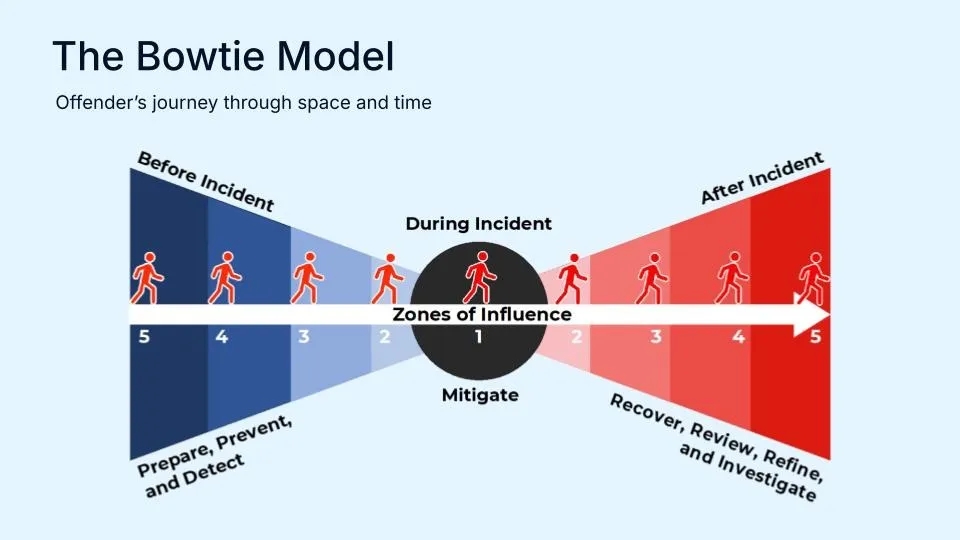
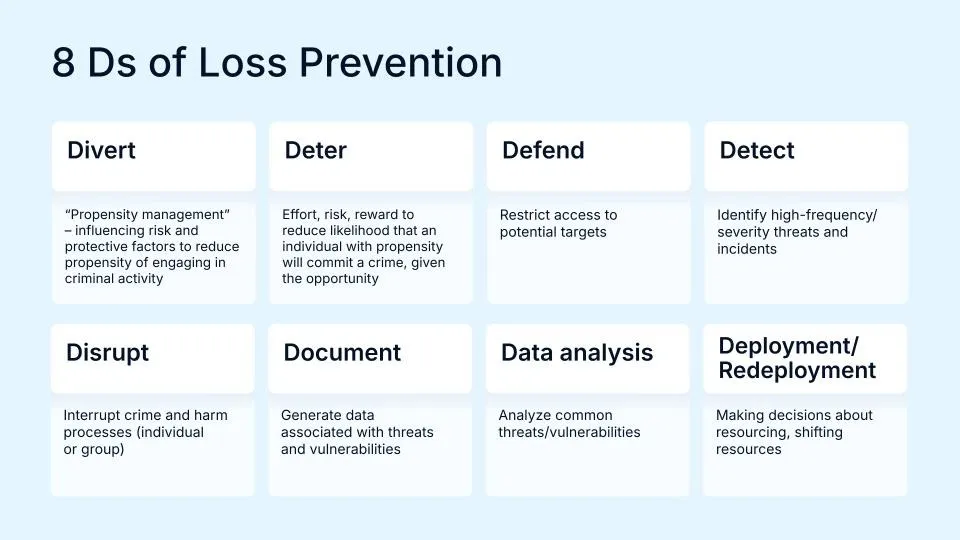
Because offending is a cycle, documentation after one incident shapes the response to the next. The bow tie model, built on LPRC Executive Director Read Hayes's five zones of influence, maps the 8 D's across that cycle, from divert and deter through to document and deploy. The correct framing is not proactive or reactive but "effectively active," meaning teams need procedures to help them be effective at all stages in the cycle.
A detection alert without context is a guess
Guessing who might be a threat is exactly where problems arise, and why responsible recognition is needed as a guardrail in retail loss prevention. The point of an effective prevention loop is to turn a flag into verified, contextual intelligence so a human can make the right call, safely.
"A detection without context means that whoever's having to deal with that is making a guess as to what might happen. And that's where bias starts to fall in. How somebody is dealt with should be based on what they've done previously rather than [what they look like]." Trevor Symons, VP of Sales, North America, Auror
Cory made a similar point: retailers know their customers well while the needed offender background often remains a mystery every time they return to a store. Locked cases charge every shopper for the behavior of a few. Context is what allows a proportionate response, rather than a reflexive or emotional one.
Two layers of detection, and a defensible record behind each one
Auror pioneered Retail Crime Intelligence as a software solution for retail loss prevention teams. Building on that Core offering, we provide responsible Risk Detection like Subject Recognition, which flags to approved retail personnel when a known high-risk person of interest has entered. As Trevor emphasized, privacy is key to responsible recognition.
“The way that we've designed our system is that no regular shopper data, if they're not in the Auror database, none of their biometrics are ever held… if there is no match and somebody else walks into the store, their biometrics are never held, which is another [way we] think about privacy first.”
Enrollment and data control sits with the retailer: recorded behavior, thresholds you set, logged access, and a human verifying every match. No biometric data held for shoppers that are not enrolled. Trevor shared that 95% of verified Subject Recognition alerts have led to no further incident.
Frictionless reporting is the foundation for any loss prevention team. It makes it possible for frontline teams to document every incident so store teams are more aware and prepared when a known high-risk individual returns. It gives a detection its meaning, and it turns a stack of incidents into a case a detective can genuinely work with. That loop is how we move closer and closer to changing the cycle of offending to reduce violent retail crime by 50% in five years.
Watch the full session to learn about the real risk of misdiagnosing an LP problem, why intelligence has to be built rather than "gathered," and advice on the stakeholder concerns to answer before you take a recognition business case internally.



.webp)