






Asset protection in retail involves recognizing and reducing the risks that threaten a retailer's people, assets, and profitability, such as theft, fraud, organized crime, and operational loss. It is broader in scope than traditional loss prevention, and the distinction matters for how programs are built and resourced.
According to the National Retail Federation's 2025 Impact of Theft and Violence Report, retailers reported an 18% increase in external retail theft incidents, and threats or acts of violence during theft events rose 17% over the same period.
This article dives into the true purpose of asset protection, how AP teams are structured, and what separates a reactive loss prevention program from one built to stop and prevent crime.
Asset protection vs. loss prevention: why the distinction matters
Walk through any major retailer's job listings, and you’ll likely find multiple titles: loss prevention associate, asset protection manager, LP investigator, and AP specialist. The terms are often used interchangeably, but they do not mean the same thing. Understanding the difference matters for how programs are built and how they are positioned inside a retail organization.
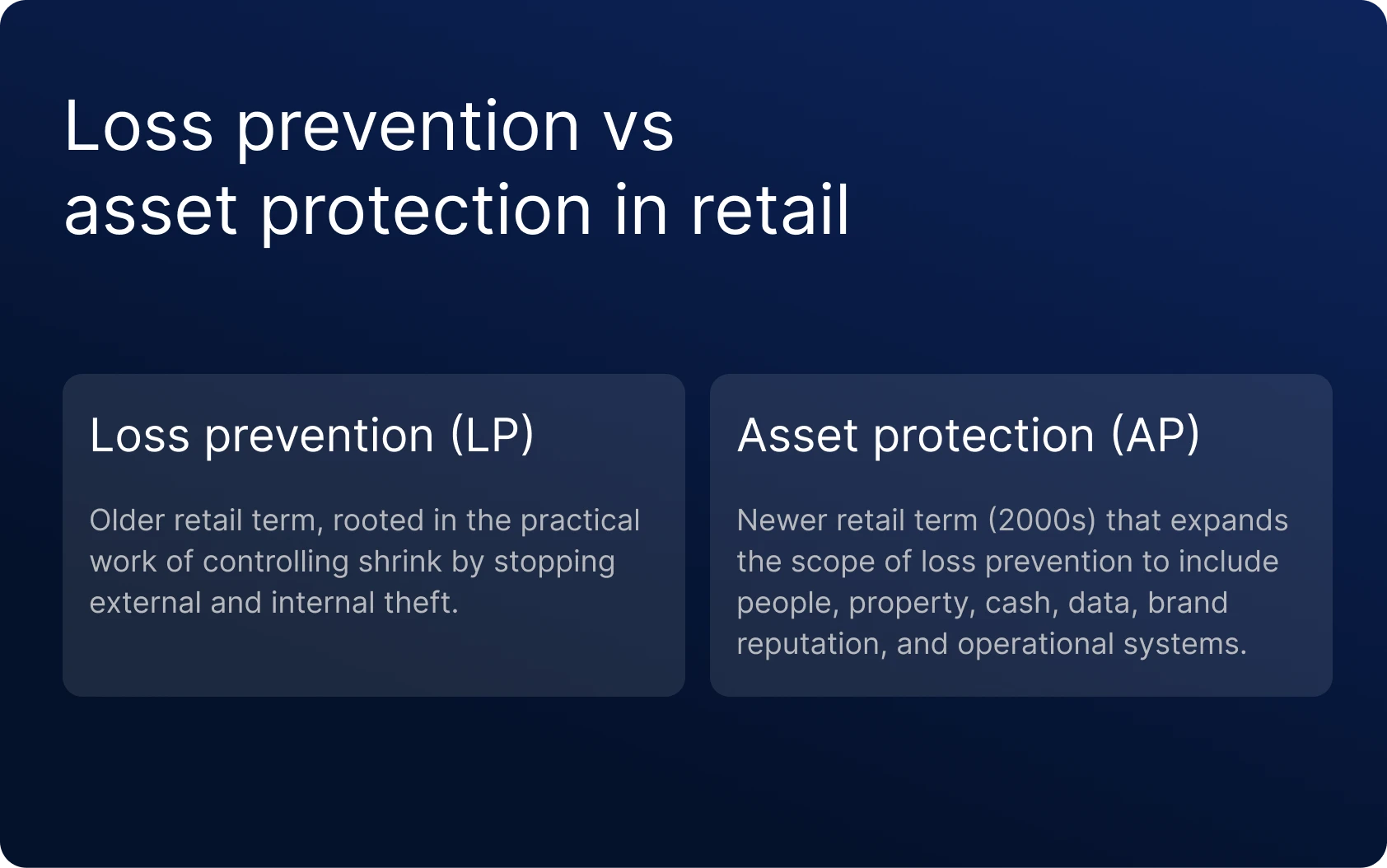
Loss prevention (LP)
Loss prevention is the older term, rooted in the practical work of controlling shrink by stopping external and internal theft, and reducing operational errors at the register. Loss prevention teams historically focused on physical security measures, floor surveillance, and incident response. The model was largely reactive, and the goal was to catch and document.
Asset protection (AP)
Asset protection emerged as a term in U.S. retail in the early 2000s, initially among large retailers that had outgrown a purely reactive approach. Where loss prevention focused on inventory shrinkage, asset protection expanded to include the people, property, cash, data, brand reputation, and operational systems that keep a store running. The asset protection role is, by definition, a proactive and comprehensive one. It asks, "What are all the ways this business is exposed, and how do we get ahead of them?"
In practice, the two terms coexist. Many retailers use "loss prevention" for frontline roles focused on store-level detection and response, and refer to "asset protection" for more senior, strategic positions overseeing enterprise security and risk management, compliance, and program governance. Others have moved entirely to "asset protection" across all titles to reflect the expanded scope. The underlying philosophy has shifted from catching loss and managing incidents to preventing loss and managing risk.
The next evolution of asset protection
Auror takes that shift one step further. The words “asset” in asset protection and "loss" in loss prevention have always been understood as lost inventory and lost revenue. But the retailers driving the most meaningful outcomes are thinking about loss more broadly: the loss of a frontline worker's sense of safety, the loss of a customer's confidence in your store, the loss of community trust when retail crime goes unchecked.
That's the thinking behind Retail Crime Intelligence, Auror's approach to the asset protection challenge. Where traditional loss prevention tools were built to document what happened, Retail Crime Intelligence addresses crime as a connected problem: connecting incidents across stores and time, surfacing the repeat offenders and organized networks behind the majority of harm, and giving retailers and law enforcement the shared intelligence to act together. Asset protection and loss prevention name the goal. Retail Crime Intelligence is how you get there.
What asset protection actually covers for retail organizations
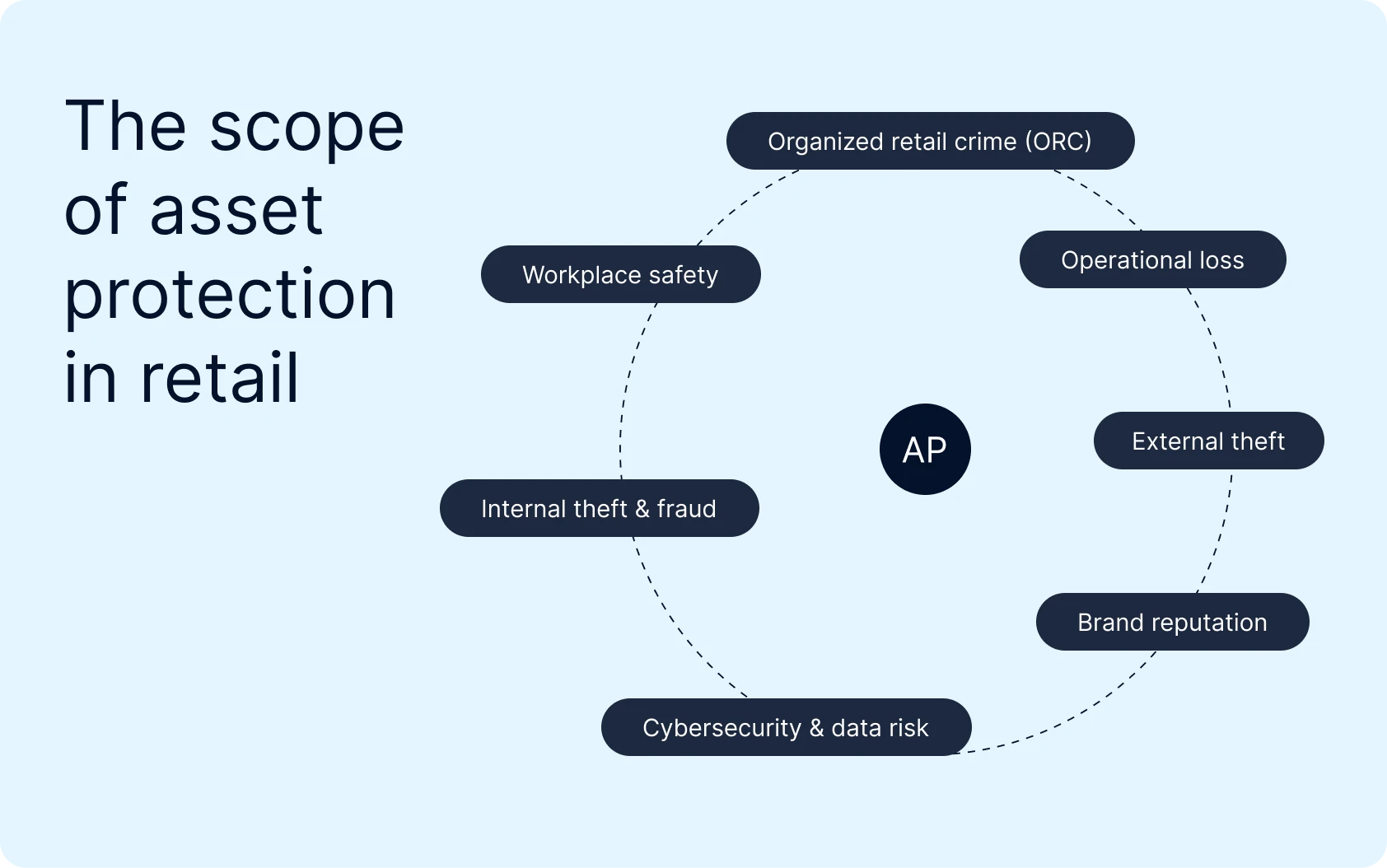
A comprehensive loss prevention program addresses shrink from theft and fraud. According to the National Retail Federation, inventory shrink exceeds $100B annually in the United States, driven by theft and fraud. A mature asset protection program goes further, treating the retailer's exposure as a portfolio of risks rather than a single category of crime.
- External theft remains the most visible threat. Opportunistic theft, grab-and-run incidents, and coordinated shelf sweeps all fall under this category. These are the events that trigger alarms, generate incident reports, and fill case management systems.
- Internal theft and fraud include employee theft, return fraud, sweethearting at the point of sale, vendor manipulation, and collusion between internal staff and external actors. Because these events often appear as operational errors rather than deliberate schemes, they require visibility across locations to detect.
- Organized retail crime (ORC) is reshaping how asset protection programs are built. ORC involves professional networks targeting multiple retailers across multiple jurisdictions, often hitting the same stores repeatedly and moving stolen goods through online marketplaces and secondary channels. Among retailers detecting ORC, incidents rose an average of 57% in recent years, according to the 2024 report from the National Retail Federation. Repeat offenders are also 5X more likely to be physically abusive. according to Auror data, making this as much a frontline safety issue as a financial one.
- Operational loss covers the shrink of administrative errors, waste, inaccurate receiving, and process failures that compound quietly across locations. These losses are harder to see without connected inventory data, shrink analysis, and exception-based reporting, which tie inventory management more directly to asset protection efforts, but they are no less real.
- Cybersecurity and data risk have become a meaningful part of the asset protection mandate as retailers handle increasing volumes of sensitive customer data, digital payment systems, and connected store technology. Data breaches, point-of-sale compromises, and loyalty program fraud represent risk and threat vectors that a modern AP program must account for, even if they sit at the intersection of AP and IT security rather than within one team's remit.
- Brand reputation and workplace safety are understated factors for asset protection. A violent incident on the store floor that appears on social media can do lasting damage to customer trust. High-liability injuries from inadequate premises maintenance expose companies legally and financially.
The threat that changed everything: organized retail crime
Organized retail crime is the clearest illustration of why asset protection had to evolve, and why "loss prevention" as traditionally practiced is no longer sufficient on its own.
Organized retail crime is, by design, a coordination problem. Boosters steal to order, fences move the goods, and organizers plan targets across regions, cycling through the same locations repeatedly and exploiting every gap between fragmented, siloed retail systems. The crime is networked. The response, historically, has not been. But as Mark Buglione, Senior Investigator at New York State Police, shared on stage at NRF Protect 2026, that’s changing with Auror:
“The network view is what is the difference between arresting just boosters or building for us a criminal enterprise case where we're identifying all the boosters, we're identifying the fencing operations, and we're able to tie that in a big conspiracy… Auror is a force multiplier.”
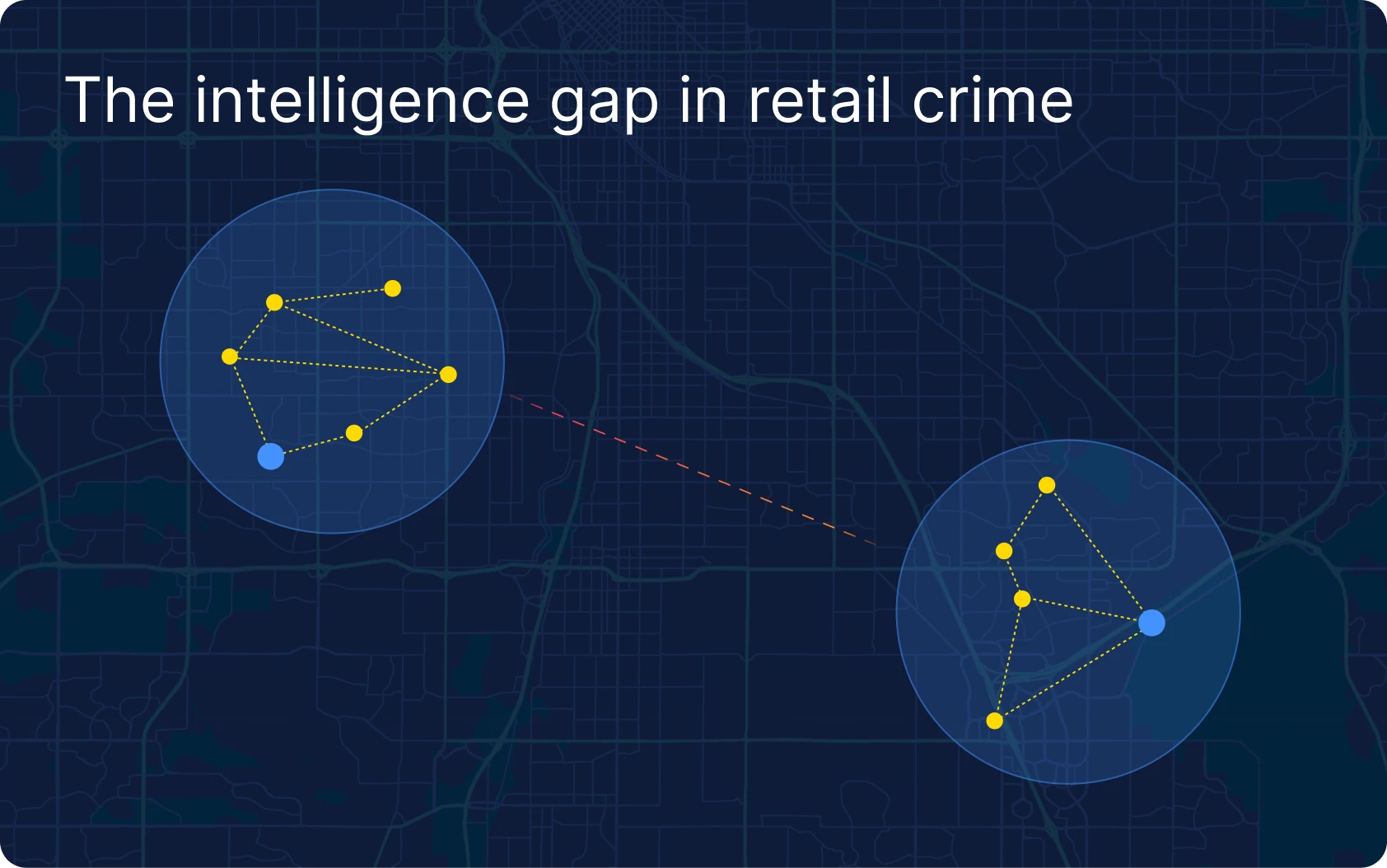
Store-level documentation and regional pattern-flagging are necessary but not sufficient. Disrupting an ORC network requires visibility that no retail business or LP team can build on their own: connected intelligence across retailers and law enforcement, the ability to surface the same person of interest (POI) across brands and jurisdictions over time, and a direct pathway to law enforcement. The pattern often tells the full story, and it only becomes visible when intelligence crosses organizational and jurisdictional boundaries.
This intelligence gap defines modern asset protection. Retailers generate significant data on retail crime every day. Without a structured way to share the data with law enforcement, it stays inside the organization.
How retail asset protection teams are structured today
Asset protection (AP) structure scales with the complexity of the retail operation, from a single store manager handling LP duties alongside other responsibilities, to a global enterprise organization with hundreds of dedicated professionals.
Typical AP team structure at mid-sized retail organizations
- In-store asset protection associates or loss prevention officers handling day-to-day surveillance, incident response, and handling employee theft situations
- Regional AP managers overseeing clusters of stores and tracking key performance indicators tied to asset protection goals and store performance
- ORC investigators working complex multi-store cases
- Data analysts running exception-based reporting and flagging anomalies
- Director or vice president of AP setting program strategy, implementing security strategies, establishing asset protection policies across stores, and reporting to executive leadership
Typical AP team structure at enterprise retail organizations
- Enterprise risk manager focusing on physical security systems, cyber risk, compliance, and business continuity, security protocols, and broader security breaches across enterprise operations
- Organized retail crime (ORC) teams are typically specialized units working across regions in close coordination with law enforcement agencies, task forces, and organized retail crime associations, and are often brought into major organized crimes that require coordinated investigation with law enforcement
Asset protection professionals today coordinate across physical stores, ecommerce operations, and distribution centers. The intelligence from each environment needs to flow into the same platform with shared case management, connected reporting systems, and identified patterns across an entire retail estate rather than just one store or one region.
Most platforms can consolidate data within a single organization. What they cannot do is connect that intelligence across retailers, or deliver it directly to the law enforcement agencies who need it to act. Auror's Retail Crime Intelligence platform is built on the premise that retail crime is a connected problem, and that the intelligence used to stop it needs to be connected too.
The asset protection role: what professionals actually do
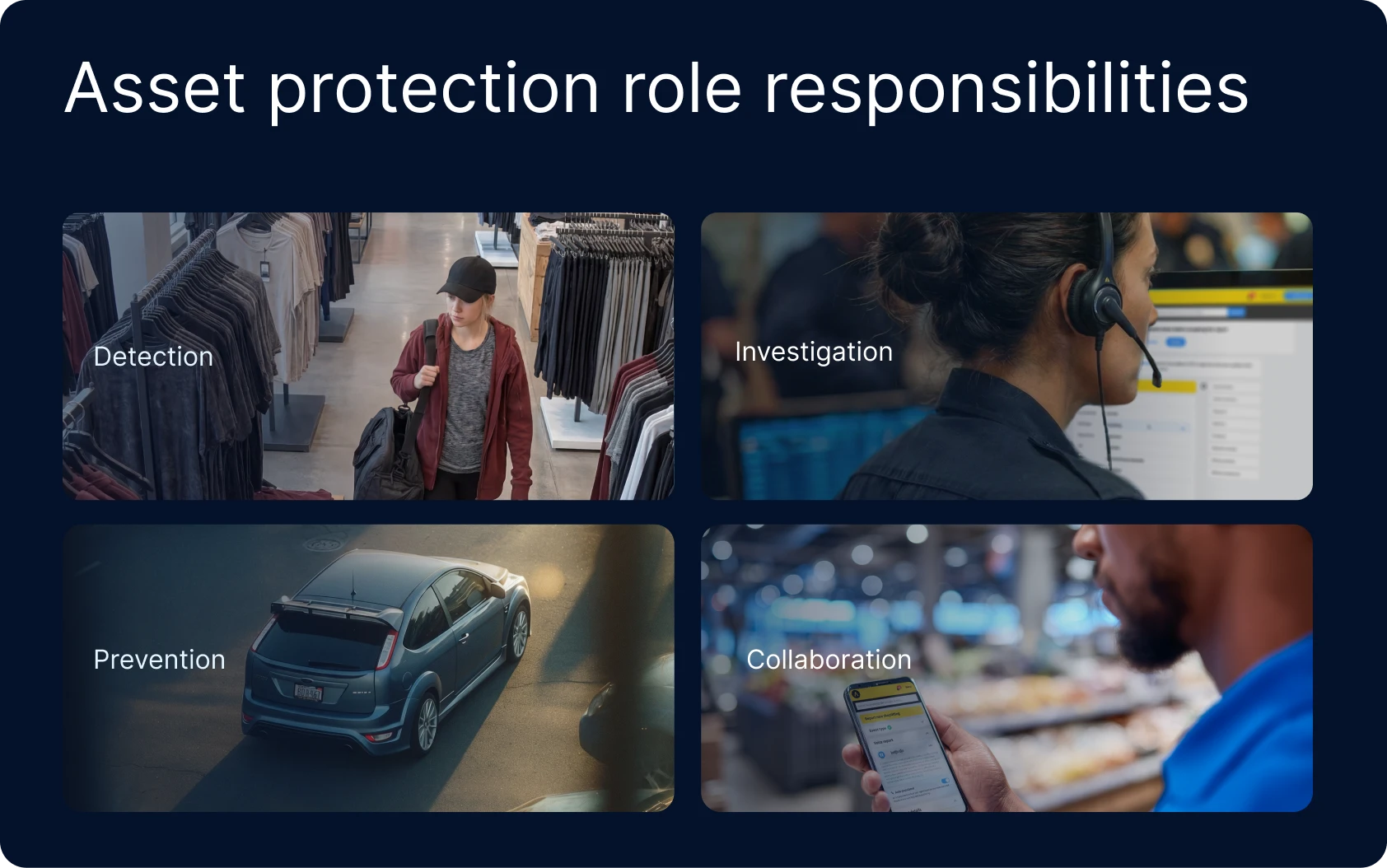
The asset protection role spans detection, investigation, prevention, and collaboration, often all at once. It demands essential skills in detection, conducting investigations, maintaining safety, and risk mitigation.
At any given time, an AP professional might be reviewing exception-based reporting flagging an unusual pattern of voids at a specific register, coordinating with a regional investigator on a case that has crossed into a neighboring district, training a store team on how to recognize and safely respond to suspicious behavior to help create a safe and secure environment for customers and employees, or preparing a structured evidence package for law enforcement.
Internal cases and ORC activity take up a significant amount of time for AP professionals. This work requires patience, analytical rigor, and the ability to connect events that may not look related at first. For employee theft situations, investigations need to follow clear asset protection policies to build a defensible case, remain fair enough to protect innocent store team members, and stay consistent enough to withstand legal scrutiny. AP professionals who can build trust across store operations teams, explain why a policy exists, and present findings clearly to legal or executive leadership are more effective across every part of the role.
Compliance and auditing have become increasingly central as programs mature. Clear security protocol reviews, policy enforcement, and operational checks across locations ensure that asset protection measures are being followed and that gaps surface before they become losses. Building and maintaining relationships with local law enforcement, coordinating with security personnel during audits and incident response, sharing intelligence through structured channels, and presenting cases that meet investigative thresholds all require thoughtful, ongoing effort.
Loss prevention strategies and tools that modern AP programs use
Effective loss prevention and asset protection programs do not rely on any single tool. They combine physical security measures, process controls, data analytics, and network intelligence to create a layered defense.
Physical security
- Electronic article surveillance with security tags that trigger alarms at exits
- Security cameras, including AI-assisted systems that surface suspicious activity in real time and use facial recognition
- Vehicle Recognition in parking lots, automatically detecting known vehicles of interest and connecting them to the persons of interest, incident history, and risk indicators.
- Locked cases for high-value merchandise like electronics and cosmetics to make theft harder
- Security mirrors and controlled entry points to eliminate blind spots
- Store design strategies that reduce concealment opportunities and reduce opportunistic theft of physical assets
Technology and intelligence
- Exception-based reporting connecting point-of-sale data to behavioral patterns, surfacing anomalies like excessive voids or unusual return volumes for human review
- AI-assisted computer vision flagging potential scan avoidance at self-checkout
- Retail Crime Intelligence surfaces where crime is concentrated, when it peaks, and who is behind it, giving AP leaders the visibility to deploy resources and make the budget case for proactive prevention
- Security Operations Centers (SOCs) provide a centralized, 24/7 hub that monitors stores in real time, triages active incidents, and processes Retail Crime Intelligence to support associates through high-risk situations.
- Radio frequency identification for real-time inventory traceability on high-value items
- Body-worn cameras connected directly to incident reports for richer evidence capture
Investigation and case management
- Structured incident capture that creates police-ready data from the moment of reporting
- Repeat offender profiles that connect related events across stores, regions, and time
- Secure workflows for confidential internal investigations, kept separate from standard reporting
- Cross-retailer case collaboration to expose organized retail crime networks operating across multiple brands
- Direct evidence sharing with law enforcement through the platform, replacing email chains and store visits
Network intelligence
- Connection of incidents across 85,000+ stores and 3,500+ law enforcement agencies through the Auror's Retail Crime Intelligence platform
- Real-time flagging of known persons of interest from existing network data
- Structured, evidence-rich cases delivered directly to law enforcement rather than isolated reports
- Compounding intelligence that strengthens for every retailer in the network with every reported incident
- Visibility into repeat and organized retail crime patterns that no single retailer could detect alone
Asset protection strategies that remain inside organizational walls are limited to what one organization can see. The retailers with leading AP programs recognize that retail crime intelligence shouldn’t stay confined to those walls.
Inadequate asset protection is not an option
A retailer with mature investigations, strong law enforcement relationships, and sophisticated data analytics is still, fundamentally, working from one organization's view of a problem that spans hundreds. That is the intelligence gap Auror was built to close.
The Auror Network connects 85,000+ stores and 3,500+ law enforcement agencies into a single retail crime intelligence layer. The repeat person of interest hitting one retailer's stores becomes visible to every retailer in the network, and the evidence that law enforcement needs to act is structured, packaged, and waiting for them rather than buried in a local case management system. Asset protection teams that join the network inherit a decade of accumulated intelligence on the persons of interest and organized retail crime groups already operating in their area.




.webp)